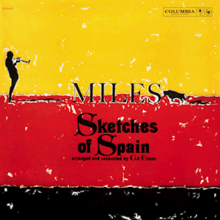
15. Miles Davis- Sketches of Spain.
I put this one on with no knowledge of what I was getting into. I loved "Kind of Blue", and expected more of the same. I was surprised. The title gives away the Spanish flavour of the entire album, but it is a mix of jazz and classical music that I have never encountered before. Apparently this type of music is classified as Third Stream.
The first track, "Concierto de Aranjuez", is a classical piece written for guitar, but it is adapted to horns with great effect. There is an underlying tension in the playing, lingering notes creating a backdrop of intensity, while everything seems to move at a slow pace, like an old western on a Sunday afternoon. I was absolutely enthralled with the piece; it changes gears like a good story with plot twists and different threads to keep us interested. I found the trumpet (or flugelhorn, my ear can't pick up the difference) to be played with that Latin fire that makes Spanish music so interesting. The notes aren't always exact, but I never felt out of my element with this track. There is a lot of depth to the music as well, you can get lost listening to the rattlesnake sounding percussion in the back. I guess I'm getting an overall sense of Mexico, or the Mexico I have seen in the movies, having never been to Spain.
The rest of the CD, to my ear, falls short of the first track. The Spanish theme continues throughout, but I recall thinking on my first listen that this could be my favourite recording of all time, and then I heard the rest of the album. At one point, and I'm not sure which track, horn shots are bleating out like a sheep on acid and I was brought back to earth. I became concerned we were heading back to Ornette Coleman territory; the uneasiness and speculation that the artist was mentally ill was looming on the horizon. The horns became more shrill, and the repetitive background music of the "Pan Piper" was entrancing.
Saeta is a very interesting track. It begins with some quiet tones and then some decidedly martial drumming and fanfare begins, before it settles suddenly back into some soloing. It's almost like watching a snake charmer; the mesmerizing drone of the other instruments behind the noodling on the trumpet. After a while, the track ends with the fanfare again. These later tracks are starting to grow on me more after two or three listens.
By the time the final track, "Solea", comes around, I think I have heard all I need to hear of the trumpet. There is more martial drumming and then a repetitive, distinctly Spanish background that gets into your head. This track really gives a feeling of movement. This is the track with the sheep and the LSD. Apparently, upon some further investigation, Saeta and Solea are types of Spanish music. Whether Mr. Davis' interpretation can be taken as a shining example of the genre, I cannot say.
This album is not as easy to listen to as "Kind of Blue", but it is very interesting. It took me through a range of emotions, which, I suppose, is the purpose. There is power in this music. It gets better with each listen as well. Rolling Stone ranked this one at 356 on the 500 Greatest Albums of All Time.
The first track, "Concierto de Aranjuez", is a classical piece written for guitar, but it is adapted to horns with great effect. There is an underlying tension in the playing, lingering notes creating a backdrop of intensity, while everything seems to move at a slow pace, like an old western on a Sunday afternoon. I was absolutely enthralled with the piece; it changes gears like a good story with plot twists and different threads to keep us interested. I found the trumpet (or flugelhorn, my ear can't pick up the difference) to be played with that Latin fire that makes Spanish music so interesting. The notes aren't always exact, but I never felt out of my element with this track. There is a lot of depth to the music as well, you can get lost listening to the rattlesnake sounding percussion in the back. I guess I'm getting an overall sense of Mexico, or the Mexico I have seen in the movies, having never been to Spain.
The rest of the CD, to my ear, falls short of the first track. The Spanish theme continues throughout, but I recall thinking on my first listen that this could be my favourite recording of all time, and then I heard the rest of the album. At one point, and I'm not sure which track, horn shots are bleating out like a sheep on acid and I was brought back to earth. I became concerned we were heading back to Ornette Coleman territory; the uneasiness and speculation that the artist was mentally ill was looming on the horizon. The horns became more shrill, and the repetitive background music of the "Pan Piper" was entrancing.
Saeta is a very interesting track. It begins with some quiet tones and then some decidedly martial drumming and fanfare begins, before it settles suddenly back into some soloing. It's almost like watching a snake charmer; the mesmerizing drone of the other instruments behind the noodling on the trumpet. After a while, the track ends with the fanfare again. These later tracks are starting to grow on me more after two or three listens.
By the time the final track, "Solea", comes around, I think I have heard all I need to hear of the trumpet. There is more martial drumming and then a repetitive, distinctly Spanish background that gets into your head. This track really gives a feeling of movement. This is the track with the sheep and the LSD. Apparently, upon some further investigation, Saeta and Solea are types of Spanish music. Whether Mr. Davis' interpretation can be taken as a shining example of the genre, I cannot say.
This album is not as easy to listen to as "Kind of Blue", but it is very interesting. It took me through a range of emotions, which, I suppose, is the purpose. There is power in this music. It gets better with each listen as well. Rolling Stone ranked this one at 356 on the 500 Greatest Albums of All Time.
Buy it here.


Comments
Post a Comment