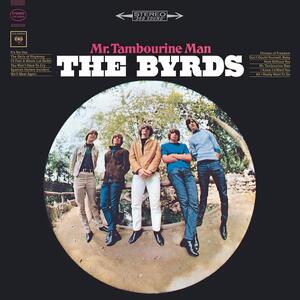
36. Mr. Tambourine Man - The Byrds.
I was looking forward to hearing the Byrds. I love the title track on this album, which affirms my suspicions that I do indeed enjoy Bob Dylan's songs, but I prefer other artists to perform them. I think I have already made that point ad nauseum, so I won't elaborate. As for the Byrds, apparently the guys in the band stood fast when the record company wanted to use session players for much of the album. Good for them. Anyhow, this album is touted as the first to blend American folk music with the new sounds of rock coming across the pond from England.
It starts out with "Mr. Tambourine Man", one of four Dylan tracks on the record. I love it. The session players were present on this track, and I have to say they did it well. I will go out on a limb and assume you have heard this song countless times, and move along. "I'll Feel a Whole Lot Better" was covered by Tom Petty, and I figure Tom was a big Byrds fan, because this is the sound he borrowed and made his own. Another Dylan tune follows with "Spanish Harlem Incident". It delivers a folky feel but with the tight drum beat and harmonies you can see what direction the Byrds are heading. I keep hearing Tom Petty in McGuinn's voice. It's rather surreal in fact, that they sound so similar. I'll try to keep it together for the rest of the album.
"You Won't Have To Cry" sounds a lot more like the Beatles than Bob Dylan. "Here Without You" sounds like many tunes later on in the sixties when things started to turn psychedelic. The vocals are haunting harmonies and the tight drum beats continue. You can hear the influence of the Beatles in the songwriting, but the sound as a whole is something completely different. It is easy to get lost listening to the harmonies. Of course, one of the voices is David Crosby, who had a little bit of success later on down the line. These are the same elements, however that make the songs run into one another. "The Bells of Rhymney" starts with the same ringing guitar notes and the harmonies are there, although there is an extended solo break in the middle featuring some aggressive tambourine shaking. I should listen closer to the lyrics, its got something to do with a coal mining disaster if I'm not mistaken. I find that the music and voices are a beautiful backdrop, almost hypnotic, and I'm not that concerned with what they are saying.
Another Dylan song comes next. "All I Really Want To Do" stands out from the other tracks. My wife was singing along with it and she was trying to figure out how she knew it. Finally, we uncovered the fact that Cher had also covered that song, as well as the previous one, "The Bells of Rhymney". Now Cher was married to Sonny Bono, who collaborated often with our gun toting friend Phil Spector. Phil Spector used the Wrecking Crew group of session musicians to create his patented Wall of Sound. Members of the Wrecking Crew were the session players who played on this album. I can imagine folks at the studio catching an earful of this new sound and wanting to get in on the action. This is absolute speculation on my part, but it is fun to connect the dots between these famous recording artists. It could also be that Cher enjoyed Pete Seeger and Bob Dylan in their own rights and recorded their songs on her own, at the same time the Byrds were doing the same thing. Perhaps it was all just coincidence.
"I Knew I'd Want You" heads back to the pre-psychedelic sounds that the Byrds were offering. I had no idea that they were such an influential band. "It's No Use" is purely psychedelic. It is also very much like a Beatles tune. The next track takes us back to folk. "Don't Doubt Yourself, Babe" has a country bassline, with the harmonies and ringing guitar over top. The highlight is some guitar with heavy echo effects playing the outro. Bob Dylan provides us with "Chimes of Freedom", and it is a straight ahead cover, to my ear, although the chorus has the now familiar harmonies, and the rock drum beat persists throughout. "We'll Meet Again" is the last song on the album, it begins with the ubiquitous jingle jangle guitar, and they sing of reconnecting under blue skies, some sunny day. A nice sentiment to close out the album.
In a nutshell, I think the whole album is bigger than its parts. The individual songs are well written, and sound lovely, but the transition into folk rock is the main story here. As noted previously, the songs do tend to run into one another due to the formula of ringing guitar notes, steady rock drums and harmonies. It is a very nice listen, and the album obviously influenced the music that came later on in the decade. And into the next decade, with Tom Petty as a seemingly unabashed disciple. And REM the decade following that. You get the idea. Rolling Stone placed this at number 232 on the 500 Greatest Albums of All Time.
"You Won't Have To Cry" sounds a lot more like the Beatles than Bob Dylan. "Here Without You" sounds like many tunes later on in the sixties when things started to turn psychedelic. The vocals are haunting harmonies and the tight drum beats continue. You can hear the influence of the Beatles in the songwriting, but the sound as a whole is something completely different. It is easy to get lost listening to the harmonies. Of course, one of the voices is David Crosby, who had a little bit of success later on down the line. These are the same elements, however that make the songs run into one another. "The Bells of Rhymney" starts with the same ringing guitar notes and the harmonies are there, although there is an extended solo break in the middle featuring some aggressive tambourine shaking. I should listen closer to the lyrics, its got something to do with a coal mining disaster if I'm not mistaken. I find that the music and voices are a beautiful backdrop, almost hypnotic, and I'm not that concerned with what they are saying.
Another Dylan song comes next. "All I Really Want To Do" stands out from the other tracks. My wife was singing along with it and she was trying to figure out how she knew it. Finally, we uncovered the fact that Cher had also covered that song, as well as the previous one, "The Bells of Rhymney". Now Cher was married to Sonny Bono, who collaborated often with our gun toting friend Phil Spector. Phil Spector used the Wrecking Crew group of session musicians to create his patented Wall of Sound. Members of the Wrecking Crew were the session players who played on this album. I can imagine folks at the studio catching an earful of this new sound and wanting to get in on the action. This is absolute speculation on my part, but it is fun to connect the dots between these famous recording artists. It could also be that Cher enjoyed Pete Seeger and Bob Dylan in their own rights and recorded their songs on her own, at the same time the Byrds were doing the same thing. Perhaps it was all just coincidence.
"I Knew I'd Want You" heads back to the pre-psychedelic sounds that the Byrds were offering. I had no idea that they were such an influential band. "It's No Use" is purely psychedelic. It is also very much like a Beatles tune. The next track takes us back to folk. "Don't Doubt Yourself, Babe" has a country bassline, with the harmonies and ringing guitar over top. The highlight is some guitar with heavy echo effects playing the outro. Bob Dylan provides us with "Chimes of Freedom", and it is a straight ahead cover, to my ear, although the chorus has the now familiar harmonies, and the rock drum beat persists throughout. "We'll Meet Again" is the last song on the album, it begins with the ubiquitous jingle jangle guitar, and they sing of reconnecting under blue skies, some sunny day. A nice sentiment to close out the album.
In a nutshell, I think the whole album is bigger than its parts. The individual songs are well written, and sound lovely, but the transition into folk rock is the main story here. As noted previously, the songs do tend to run into one another due to the formula of ringing guitar notes, steady rock drums and harmonies. It is a very nice listen, and the album obviously influenced the music that came later on in the decade. And into the next decade, with Tom Petty as a seemingly unabashed disciple. And REM the decade following that. You get the idea. Rolling Stone placed this at number 232 on the 500 Greatest Albums of All Time.
Buy it here.


Comments
Post a Comment